Mapo kaiseki course with jamón starter and fried chicken: Danya
In short
Danya at Seoul Garden Hotel is a Japanese restaurant on the basement level of Seoul Garden Hotel on Mapo-daero in Mapo, Seoul, serving a premium kaiseki course rather than sushi omakase. The course ran about two hours, from a jamón and cheese starter through five appetizers, steamed abalone in snow crab innard sauce, seven kinds of sashimi, snow crab miso soup, sushi on red-vinegar rice, fried chicken tenderloin and 1++ hanwoo striploin, cold bukkake udon and a conger eel rice bowl, to dessert. Danya suits diners who care about how a whole course flows more than the perfection of a single piece of sushi.

Good to know
- Address
- B1, 58 Mapo-daero, Mapo-gu, Seoul (Seoul Garden Hotel)
- Hours
- Mon–Sat 12:00–22:00, break 15:00–18:00, last order 21:00
- Closed
- Every Sunday
- Ordered on this visit
- Premium kaiseki course + draft beer
- Course length
- About 2 hours
- Parking
- Valet behind the hotel, 4,000 won valet fee / 3 hours free with a meal at Danya
- Price reference
- ₩4,000 ≈ $3 (2026-09-30)
as written by the visitor on Aug 14, 2026
I visited Danya, the Japanese restaurant inside Seoul Garden Hotel. This time I tried something different from the sushi omakase I usually go for — the premium kaiseki course.
Honestly, from back when I was dating my now-husband, I've eaten a lot of sushi at various omakase spots — Gongdeok's Iyoiyo, Yeouido's Aruhi, Sushi Yutaka, Sushi Dajeong, Ilsan's Sushi Mitz, Gimpo's Papa Sushi, to name a few. At some point I got curious about kaiseki, which experiences the whole of Japanese cuisine as one course, rather than omakase that centers on fish and sushi.
That's how I found out Danya, inside the basement of Seoul Garden Hotel, serves a kaiseki course. I was especially excited to hear that Danya's chef, Nam Jeong-gang, was runner-up at Japan's national cooking competition 'Gourmet Pitch.'
After about two hours of eating through the course, though, I didn't just think 'this was a good Japanese restaurant' — I felt like I'd experienced a completely different way of eating from omakase.
Kaiseki vs. omakase: what is the difference?
I used to think kaiseki and omakase were more or less the same thing. Strictly speaking, though, they're not.
Omakase (おまかせ) literally means 'I'll leave it to you' — a dining style where you leave the menu choices to the chef. Kaiseki (懐石料理), on the other hand, is closer to a Japanese food culture where various dishes are served in a set flow to complete one whole meal as a single course. It's characterized by moving through appetizers, sashimi, steamed or grilled dishes, a rice course, and dessert, shifting cooking methods, textures, and flavors along the way.
To put it simply,
If omakase is 'leaving what to eat up to the chef,' kaiseki is 'enjoying the entire meal as one flow.'
The course I had at Danya also moved in this order over about two hours: starter → appetizers → steamed abalone → sashimi → snow crab miso soup → sushi → specialty dishes → rice course → dessert.
Where is Danya, the Japanese restaurant at Seoul Garden Hotel?
Danya at Seoul Garden Hotel is a Japanese restaurant on the basement floor (B1) of Seoul Garden Hotel, 58 Mapo-daero, Mapo-gu, Seoul, South Korea. Seoul Garden Hotel holds a slightly special meaning for me.
When I got married in Seoul, my father's side of the family, who live in Busan, couldn't make it up on the morning of the wedding, so they all stayed together at Seoul Garden Hotel the night before. So I have a bit of personal fondness for this hotel. This time I came to Danya, the Japanese restaurant on its basement floor.
- 📍 Address: 58 Mapo-daero, B1, Mapo-gu, Seoul, South Korea
- 🕑 Hours: Mon–Sat 12:00–22:00 (break time 15:00–18:00 / last order 21:00)
- Closed every Sunday
- 🅿️ Parking available
Danya's dining room is more casual than expected
Danya's atmosphere was much more relaxed and casual than what the word 'kaiseki' might bring to mind. Kaiseki tends to conjure an image of a quiet, formal setting reserved for special occasions, but that wasn't quite the case here.
Looking around that day, I saw office workers having a drink after work, couples on dates, and groups of friends or men out together. There was the cleanliness you'd expect from a hotel Japanese restaurant, but no oppressive sense of formality.
So I actually thought this would work well for a lot of situations — dates, anniversaries, a work dinner, or drinks with friends.


What is on Danya's premium kaiseki menu?
Here's the menu — we had the premium kaiseki course plus draft beer that day. Now let me go through everything we ate over those two hours, in order.


1. Draft beer and the jamón and cheese starter
The course started with a glass of draft beer. The first dish out was a starter of hamon (Spanish cured ham), melon, and cheese.
The salty, aged hamon was followed by the gentle sweetness of the melon and the nutty, soft richness of the cheese. The melon's sweetness balanced the hamon's saltiness, and the cheese tied it all together smoothly. Rather than hitting hard right from the first bite, it felt like it gently opened up the palate.


2. Five appetizers
Five appetizers came on one plate: braised conch, hairtail with pollock roe, fig cream cheese, tomato compote, and nishikitamago (Japanese layered egg). The chef told us to eat the tomato compote last.
Braised conch — a subtly sweet soy glaze with the conch's chewy texture still intact. The seasoning added savoriness rather than masking the conch's flavor, so its natural sweetness came through the more you chewed.
Hairtail with pollock roe — the hairtail was soft and clean-tasting. The pollock roe's saltiness and aroma didn't overpower it, just added a bit of extra savoriness.
Fig cream cheese — the fig's mild sweetness with the soft, nutty richness of the cream cheese. It seemed to serve as a change of pace among the seafood-heavy appetizers.
Tomato compote — I understood why the chef said to eat this one last. Rather than a strong acidity like a tomato marinade, the tomato's own sweetness and aroma came through. It was great for refreshing the palate after the earlier appetizers.
Nishikitamago — a sweet, extremely soft egg dish. Moister and fluffier than a regular rolled omelet, with a texture that felt a bit like castella cake.
3. Steamed abalone in snow crab innard sauce with fried scallion
This was personally one of the most impressive dishes that day. Abalone topped with snow crab innard sauce and fried scallion strips.
The abalone had almost no chewiness — it was quite soft, while still keeping the characteristic springy, tender bite of abalone. The snow crab innard sauce had no fishy smell, just a nutty, creamy richness.
And surprisingly, the fried scallion strips were the standout element. The crispy scallion strips lifted the aroma and savoriness right up. Soft abalone + creamy crab innards + crunchy scallion — the textural contrast on one plate was really fun.
4. Seven kinds of sashimi
And then, the sashimi proper: halibut / greater amberjack / sea bass / halibut fin / striped jack / tuna belly / red seabream.
What stuck with me most during the sashimi course wasn't the food itself but something the chef said.
"Danya's sashimi is more 'medium-rare' than 'well-done,' so to speak."
And also,
"Rather than a punch of flavor all at once, Danya's style is a savoriness that rises gently and slowly — that's our characteristic."
Eating it, I could kind of see what he meant. Instead of hitting you with a strong aged aroma or deep umami all at once, the flavor spread slowly in the mouth, with the fish's richness building up the more you chewed.


Halibut — clean with a subtle sweetness, and a good springy bite. A clean, familiar halibut flavor.

Greater amberjack — the tastiest sashimi of the day. Not just soft, but springy and pleasantly crunchy. Rather than immediately giving way when bitten, it had some resistance before slowly softening, bringing up the fatty richness typical of the amberjack family.
Sea bass — cleaner and more restrained than the amberjack. A good springy chewiness kept the clean flavor from feeling plain.

Halibut fin — a clearly different appeal from the halibut's lean flesh. The fin area had a distinctly fatty, nutty richness and a chewy texture.
Striped jack — also impressive, though I was too busy eating to get a close-up shot, which I only realized while writing this post. It had the nutty fattiness typical of striped jack along with a pleasantly springy crunch, with the fat melting softly through the firm flesh.
Tuna belly — at first it melted softly in the mouth, almost dissolving. But toward the end, a bit of sinewy texture remained, giving it both softness and chewiness at once.
Red seabream — the last piece, quite clean and soft. The flesh was smooth and firm, yet gave way gently rather than resisting when bitten.

5. Snow crab miso soup
After the sashimi came the snow crab miso soup. Miso soup in a sushi course is usually just a light accompanying broth, but this one had a generous amount of snow crab meat — enough to pick apart and eat directly.
The salty, savory miso combined with the crab's natural sweetness for a fairly rich bowl. Sipping a spoonful between bites of sushi warmed and reset the palate, leaving a subtle sweetness from the crab. It was so good I asked for a refill.

6. Eight pieces of sushi on red-vinegar rice
Now for the sushi proper. The chef shaped each piece by hand right in front of us at the table. Since the same fish we'd had as sashimi reappeared as sushi, it was fun to compare how each ingredient changed between the two forms.
The first thing that caught my eye about Danya's sushi was the reddish rice. The chef explained the rice was seasoned with Japanese red vinegar, giving it a deeper, reddish-brown color compared to typical white sushi rice.
Tasting it, the vinegar's acidity wasn't overpowering, and each grain of rice was distinct. Rather than clumping into one mass, the rice separated pleasantly, grain by grain. The amount of rice was well balanced with the fish — not too much or too little.
That day's sushi went: sea bass → flathead grey mullet → red seabream → greater amberjack → striped jack → bluefin tuna → bluefin tuna medium-fatty cut → tuna belly negitoro + sea urchin + gamtae (seaweed).
Tuna belly negitoro + sea urchin + gamtae — the most memorable piece of sushi that day. Minced tuna belly topped with sea urchin and wrapped in gamtae (a savory dried seaweed). The rich, melting fattiness of the tuna belly combined with the creaminess of the sea urchin and the salty, fragrant sea aroma of the gamtae. A touch of grated yuzu peel on top was the finishing note — its fragrant aroma and bright acidity cut cleanly through the heavy richness of the tuna and urchin.
Complimentary snow crab sushi — at the very end, we got a complimentary piece of snow crab sushi, made by lightly blanching picked crab meat. Rather than a strong crab aroma, it had a soft, moist texture with the distinct grain of the snow crab meat coming through.
7. Hot dish ①: fried chicken tenderloin in meat sauce
After the sushi came the specialty dishes. First up: fried chicken tenderloin in meat sauce.
The chicken tenderloin was soft inside and crisply fried outside. Asparagus and bell pepper inside added a crunchy texture and mild sweetness to the tender chicken. The meat sauce brought a deeper savoriness. After the light, delicate Japanese flavors that had come before, this dish shifted things toward a richer, more Western style of flavor.


8. Hot dish ②: 1++ hanwoo striploin with vegetables and basil cream sauce
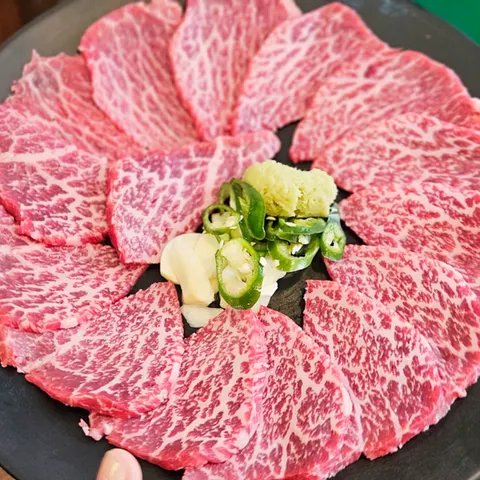
The second specialty dish was grade 1++ hanwoo (Korean beef) striploin with vegetables and basil cream sauce. The striploin had a nutty richness from the fat along with a gentle hanwoo meatiness. A tiny bit of salt and a touch of wasabi made the meat's own flavor come through much more clearly.
My favorite combination personally was hanwoo striploin + salt + wasabi + vegetables lightly dipped in basil cream sauce. The basil's fragrance and the cream's softness paired well with the hanwoo's rich flavor.
9. Rice course: cold bukkake udon and conger eel rice bowl
The last savory course was bukkake cold udon and conger eel (anago) rice bowl. The bukkake udon centered on the salty, savory flavor of the tsuyu dipping sauce, and the cold, chewy noodles felt refreshing this late in the course.
The conger eel in the rice bowl was extremely soft. Eating it with ginger cleaned up the eel's sweet, tender flavor with a crisp aromatic edge. There was a very faint hint of bone, but it was so soft it barely registered.
10. Dessert: pickled peach with raspberry and cream cheese sauce
The final dessert was pickled peach with raspberry sauce and cream cheese sauce. The peach had a soft, juicy texture, closer to a soft peach than a firm one.
The tangy-sweet raspberry sauce and the soft, nutty cream cheese sauce came together for a refreshing finish to the course. Warm green tea was served at the very end. And that was the close of the roughly two-hour premium kaiseki course.


How to park at Danya in Seoul Garden Hotel
Turn right at the main entrance of Seoul Garden Hotel to reach the parking lot behind the hotel. It's valet parking — just leave your keys in the car when you get out — and the valet fee is ₩4,000.
After eating at Danya, you can get a 3-hour free parking discount, so I'd definitely recommend registering for it. You can also pay the valet fee by card at the prepayment kiosk, which was conveniently located both at the parking lot entrance and in front of the elevator by Danya.


Looking for kaiseki, not omakase, in Seoul?
The most interesting thing about this visit to Danya was that I stopped judging the course purely on 'how good is the sushi.' With omakase, you naturally end up focusing on the rice, the fish, the aging, the perfection of each individual piece.
Kaiseki was a bit different. The appetizers showed off a range of flavors, the steamed abalone added richness through the dish and sauce, the sashimi showed off different textures and fattiness fish by fish, and the snow crab miso soup reset the pace once. Then the red vinegar sushi rice tied the fish and rice back together, the fried chicken and hanwoo striploin expanded the range of flavor, and the cold udon and conger eel rice bowl brought the meal to a close. And finally, peach and green tea.
Food that's about the arc of the whole course rather than the intensity of any one dish. That's the kind of food kaiseki turned out to be for me this time.
And Danya wasn't as difficult or formal a space as I'd expected. From office workers having a drink after work, to couples on dates, to groups of friends, all kinds of people were enjoying their meal comfortably. So I actually think it's a less intimidating space for someone trying kaiseki for the first time.
It would suit a special-occasion meal, of course, but also anyone in Mapo, Seoul looking for a Japanese course meal that's a bit different from omakase, anyone curious about kaiseki, or anyone who wants to slowly enjoy an evening with a drink.
Above all, what the chef told me that day stuck with me.
"Danya's sashimi is more 'medium-rare' than 'well-done.'"
And also,
"Not a punch of flavor all at once, but a savoriness that rises gently and slowly."
After finishing the course, I thought that description fit Danya's food style pretty well. Rather than being remembered for one strong hit, it's a meal where, piece by piece, at some point the whole course sticks with you. This first proper experience of Seoul Garden Hotel Danya's premium kaiseki felt like it would stay in my memory that way for a long time.
Where it is
58 Mapo-daero, B1, Mapo-gu, Seoul, South Korea서울특별시 마포구 마포대로 58 지하 1층