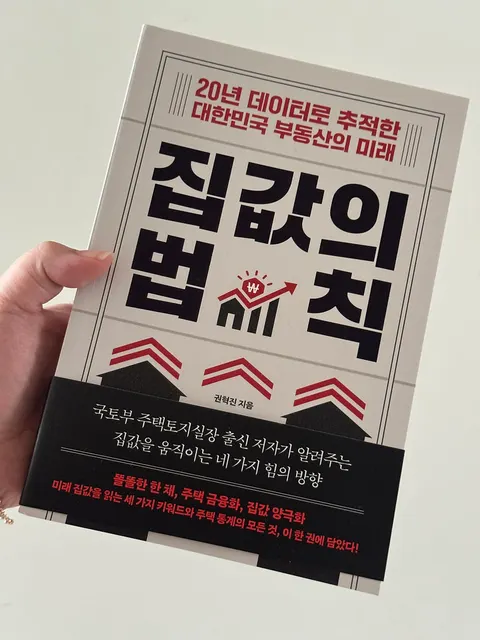
Real estate book on rates, income and rent: The Law of Housing Prices
In short
The Law of Housing Prices (The Law of Housing Prices) is a Korean nonfiction book on real estate by a former head of the Housing and Land Office at Korea's Ministry of Land, Infrastructure and Transport. It explains how home prices move using data on apartment sale prices, household income, interest rates, money supply and jeonse (lump-sum deposit lease) and monthly rent ratios. It also covers the rule of 72, Seoul apartment prices against household income from 2012 to 2025, how sale, jeonse and monthly rent prices connect, and how to look up the statistics yourself. The Law of Housing Prices does not predict home prices; it shows you what to watch.

Good to know
- Book
- The Law of Housing Prices (The Law of Housing Prices)
- Author's background
- Former head of the Housing and Land Office, Ministry of Land, Infrastructure and Transport
- Data covered
- Apartment sale prices, household income, interest rates, money supply, jeonse and monthly rent ratios
- Comparison period
- Nationwide and Seoul apartment sale prices vs. household income, 2012–2025
- Appendix
- How readers can find the statistics themselves
Prices as written by the tester on Sep 29, 2026 · not updated automatically

What kind of book is The Law of Housing Prices?
The Law of Housing Prices is a real estate book that teaches you to look at housing prices through data instead of gut feeling or forecasts. Whenever you follow real estate talk, there's one question you hear the most: "Will housing prices go up or down from here?"
Someone says prices will rise because supply is short. Someone else says they'll fall because interest rates are high. Another person says prices are bound to fall in the long run because the population is shrinking. But listening to all these conflicting forecasts just leaves you more confused.
The Law of Housing Prices, which I just read, is a book that teaches you to look at this kind of housing price talk through data rather than gut feeling or forecasts. The line on the back of the cover — "The more anxiety grows about housing prices, the more you need the ability to read data, not predictions" — feels like it really captures the direction of the book.


A book that explains what moves housing prices, using data

The author of The Law of Housing Prices is a former Housing and Land Bureau director at the Ministry of Land, Infrastructure and Transport, and built the book on years of closely watching housing policy and the real estate market. But it's not simply a book of the author's experience or opinions.
Throughout the book, data on apartment sale prices, household income, interest rates, money supply, and jeonse/monthly rent ratios is used to explain why housing prices moved the way they did, and what indicators to check when looking at the real estate market going forward. So it felt less like a book teaching real estate investing and more like a book teaching how to interpret the real estate market.
So, how much more have housing prices risen than inflation?

One of the more interesting parts of The Law of Housing Prices was the section explaining why people invest in assets like real estate — because inflation erodes the purchasing power of cash over the long run. It also explains basic financial concepts like the Rule of 72, which helped me understand not just real estate but how asset value changes over long periods in general.
For example, at a 2% annual return, it takes about 36 years for an asset to double — a simple concept, but a great way to grasp the meaning of long-term investing and compound interest.


How much faster have Seoul apartment prices risen than income?
The Law of Housing Prices shows changes in nationwide and Seoul apartment sale prices alongside household income from 2012 to 2025. Income also rose steadily, but Seoul apartment prices in particular rose much faster than that.
Seeing something I only vaguely knew as "prices have gone up a lot" compared in actual numbers felt different. The book goes a step further and also shows that assets, not just income, are becoming polarized. It helped me understand why the real estate market is hard to explain with just one variable, like the simple idea that "prices will fall because the population is shrinking."

How are sale prices, jeonse, and monthly rent connected?
One of the personally most useful parts of The Law of Housing Prices was the relationship between sale prices, jeonse (lump-sum deposit lease), and monthly rent. (Probably because that's the information I need the most, haha.)
It's easy to think of these three prices separately in everyday life, but the book explains that they're closely linked to each other. It was especially interesting to see why jeonse-to-monthly-rent ratios differ by region and housing type. What stuck with me was the point that you need to look at the sale, jeonse, and monthly rent markets together, not just housing prices alone, to get a fuller picture of real estate trends.

It even shows you how to find the statistics yourself
One thing I really liked about The Law of Housing Prices! It doesn't just show you graphs and statistics and stop there — the back of the book lays out how readers can find the statistics themselves.
When reading real estate or economics books, you often end up wondering, "So where do I actually check this data?" I liked that this book tells you how to find and verify the data yourself.
A book that tells you what to look at, rather than predicting prices
The biggest thing I took away from reading The Law of Housing Prices was that you shouldn't look at the real estate market through just one variable. Interest rates matter, supply matters, income and assets matter. Money supply and the jeonse/monthly rent market also affect each other.
So rather than a single line like someone's "housing prices will definitely go up" or "prices will fall because the population is shrinking," what matters is checking the data behind that judgment yourself.

Who is The Law of Housing Prices for?
Even if you're not someone who needs to buy a house right now, if you're curious about how the real estate market structurally moves, and how indicators like interest rates, income, and jeonse prices that you hear about in the news connect to housing prices, The Law of Housing Prices is worth reading.