Seonleung eel rice bowl with wild pine mushroom soup: Manmok
In short
Manmok is a Japanese restaurant near Exit 2 of Seonleung Station in Gangnam, Seoul, specialising in Gochang freshwater eel. Manmok serves Kanto-style eel rice bowls — the eel is grilled once, steamed, glazed and then grilled again over charcoal — and two of us ordered a half portion at 26,000 won and a whole portion at 39,000 won to compare them with the Kansai-style eel eaten in Fukuoka; Manmok's eel was soft and clean-tasting rather than chewy. With pickled whole sancho peppercorns and wasabi, wild pine mushroom soup and matcha and black tea ice cream to finish, Manmok also works as a quiet spot for a team dinner.
Good to know
- Location
- 9 Seolleung-ro 82-gil, Gangnam-gu, Seoul, 1st floor (about 273m from Seonleung Station Exit 2)
- Hours
- Daily 11:00–22:00, break 15:00–17:00
- Last order
- 14:20 / 21:20
- Eel rice bowl, half portion
- 26,000 won
- Eel rice bowl, whole portion
- 39,000 won
- Parking
- 2 cars in front of the restaurant (tight space, calling ahead recommended)
- Nearby parking
- WeWork Seolleung 3, Samjeong Building, Areumvil, Nice Park (mechanical)
- Eel origin
- Gochang freshwater eel
- Price reference
- ₩26,000 ≈ $19 · ₩39,000 ≈ $28.5 (2026-09-26)
as written by the visitor on Aug 13, 2026
How Manmok's Seonleung eel rice bowl differed from the eel I ate in Fukuoka
In Korea I feel like eel is usually eaten grilled or in soup, so I got curious about what an eel rice bowl tastes like here. I went to Manmok near Seonleung Station for lunch with a friend. Apparently in Japan eel dishes are classified into Kansai style, Kanto style, and Nagoya style — and since I happened to remember eating an eel rice bowl on a trip to Fukuoka before, I was curious how different it would be.
Manmok location, hours and parking near Seonleung Station
Manmok is at 9 Seolleung-ro 82-gil, Gangnam-gu, Seoul, about 273m from Seonleung Station Exit 2. It's open daily 11:00–22:00 with a break time from 15:00–17:00, and last orders are at 14:20 and 21:20.
- Parking: 2 spots in front of the restaurant (tight space, call ahead recommended)
- Nearby parking: WeWork Seolleung 3 (428 Seolleung-ro, Gangnam-gu, Seoul), Samjeong Building parking (7 Seolleung-ro 86-gil, mechanical), Areumvil parking (11 Seolleung-ro 86-gil, mechanical), Nice Park (20 Teheran-ro 64-gil, Wondongbang Building, mechanical)
- Prices: eel rice bowl half portion ₩26,000 / whole portion ₩39,000
I walked from Exit 2 following Naver Maps and found it in one go without getting lost — it's not that far from the exit, so it's an easy walk.

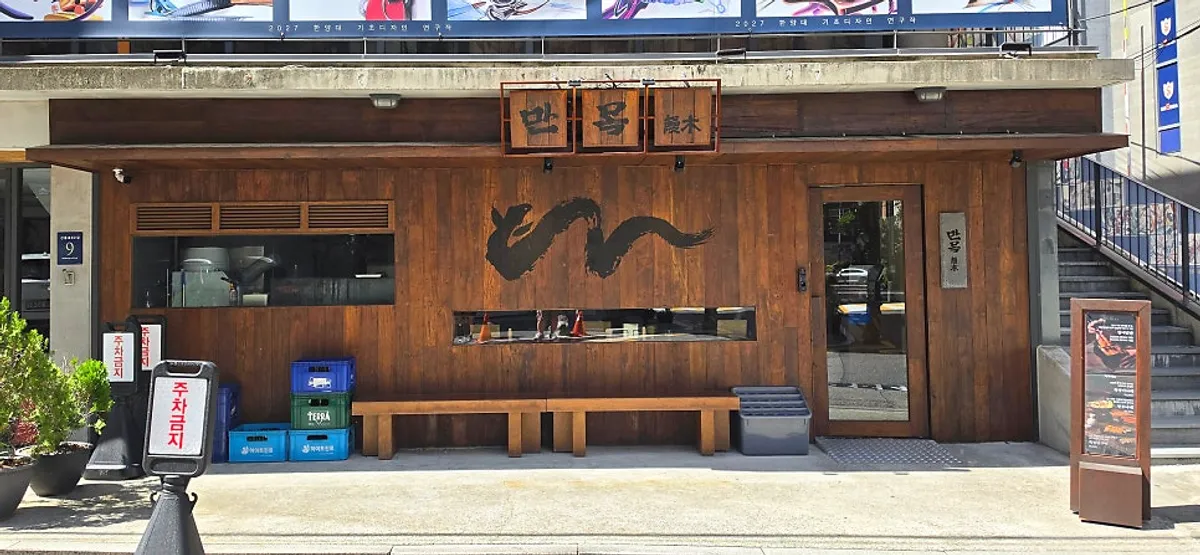
The first thing that caught my eye was the wooden wall painted with an eel design out front, plus a standing sign listing eel rice bowl, special eel nabe, and more. Even before going in, the place clearly identifies as an eel specialty Japanese restaurant, and my trust in it shot up ⏫ — that feeling is always nice!


Inside Manmok: does it work for a quiet team dinner?
Walking inside, the warm feel of the wood combined with soft lighting made for an overall calm, clean atmosphere.


The place isn't actually that big, but the spacing between seats felt generous — it seemed tidy, probably because of the table layout and interior. Wine-colored accents, dark brown wood, tables that look like dark gray-black stone, and soft hanging shade lamps all come together. It's dark and heavy but gives a very neat, polite impression — like stepping into a high-end restaurant in Japan itself. You don't need Japanese props hung all over the place; the feeling just comes through naturally. It's a good atmosphere for talking over a meal, so I think it could work well as a group dinner spot near Seonleung Station.
1. Half portion vs whole portion: we tried both
Since we came as two, I ordered one eel rice bowl half portion (₩26,000) and one whole portion (₩39,000). Each comes on its own wooden tray for one person, along with wild pine mushroom soup, sancho pepper pickles, wasabi, pickled ginger, a plate of assorted takuan (pickled radish), sesame dressing salad, Japanese-style steamed egg custard chawanmushi, wooden chopsticks, and two spoons of different sizes. White kimchi and julienned kimchi come as side dishes too.


Cutting the eel with chopsticks, the flesh fell apart softly, while the skin side was chewy and springy. The different textures between flesh and skin were both delicious and fun.


Manmok says it only uses Gochang freshwater eel, considered one of the best eel-producing regions. The eel is wider than a roll of packing tape, and looking at it from the side, the flesh was quite thick. Both the half and whole portions use the same eel. Portion-wise, the half is right for light eaters, and the whole is a normal single-meal amount. This time I ordered both to compare, but next time I'll probably just get the whole portion — good food is more satisfying eaten to full. 🙆♀️🙆♂️
2. Why Kanto-style eel tastes different from Fukuoka's Kansai style
The eel rice bowl I had in Fukuoka this past May had a thick, sweet sauce soaked deeply into the rice and eel, with an overall chewy texture — but Manmok's eel felt completely different from the very first bite. The menu at Manmok explains that they cook their eel rice bowl Kanto style.
Kanto style splits the eel along the back, grills it once, steams it, then glazes it and grills it again. At Manmok, the eel is grilled once, steamed, glazed with their signature sauce, and then grilled twice more over charcoal. Through this process, the greasiness disappears, leaving only softness and a clean taste, they say. Meanwhile, the Unagiya restaurant I visited follows Kansai style — no steaming, grilled directly over charcoal — giving a crispier outside and chewier inside. Same dish, but such different results depending on the cooking method — experiencing that firsthand rather than just reading about it made eating even more fun.


3. The side plate that lifts the eel: pickled sancho peppercorns, wasabi, pickled ginger and takuan
The accompaniments on the tray had a presence of their own too. The staff served the wooden tray and explained each dish one by one — I had to ask about the sancho pepper pickles a few times. It seems like an unfamiliar item, and honestly the name itself isn't easy either, right?

Very unusual experience #1: the sancho pepper I knew had a fairly strong aroma, but the pickled version at Manmok was more subtle than I expected. Put a little on the eel and instead of hitting you sharply, it lingers gently in your mouth — so it wasn't overwhelming to eat with the eel. My friend, who's a picky eater, casually ate the sancho pepper with the eel even though it was her first time trying it. She said it was delicious. Haha.
The staff mentioned that if the pickled sancho feels too strong, you can try the sancho powder instead — the powder form is milder and gentler than the pickle. It was fun comparing the two back and forth. It came in a small wooden container, like in the photo, and it seemed you remove the round wooden piece at the bottom to sprinkle the powder out.

The wasabi was also really good — subtle enough that it paired well with the clean-tasting eel. Eel, wasabi, and sancho pepper together made for a fragrant, layered mouthful — exaggerating a little, it felt like meeting the universe. Highly recommend this combo 🤩
The white item I thought was pickled radish for wraps turned out to be takuan — but white in color, and tasting more like dongchimi radish than the usual sweet-and-sour kind. Quite different from the takuan I know, so that was a fun experience too. The pickled ginger wasn't too different from what you get at sushi restaurants. Alternating between these pickles and the eel was nice for cleansing the palate between rich bites.


The side julienned kimchi and white kimchi tasted like what you'd get at a home-style Korean meal restaurant — properly made julienned kimchi, properly made white kimchi. The julienned kimchi was spicy but tasty, so I kept eating it and my mouth got even spicier. As a Korean, kimchi is always a welcome sight, haha. After eating eel, a bite of white kimchi really cleared the palate. More than the takuan or pickled ginger, white kimchi wins 👍

4. Steamed egg custard, wild pine mushroom soup and sesame dressing salad
Manmok's chawanmushi comes with shrimp in it. It has the expected pudding-like texture, infused with the flavor and aroma of shrimp. The slight fishiness of the egg and the shrimp didn't clash — they blended into a savory depth instead. The rich broth base wrapped around both the egg and shrimp flavors to complete one unified dish. Biting into the whole shrimp and feeling that plump texture each time was also great. I ate it last as a palate cleanser — even cold, it wasn't fishy at all and actually settled my stomach, so I'd recommend it as a closing dish too.


Very unusual experience #2: this was my first time having soup made with wild pine mushrooms. I was personally a bit surprised that such an expensive mushroom would go into a soup. 😲 The broth had a familiar taste, like a bonito udon broth, but with chili powder mixed in for a spicy kick that made me cough a little. Spicy but clean and refreshing, I liked it. The real highlight was the mushroom itself — I assumed it wouldn't have much aroma or flavor in the soup and might be bland, but wow, the pine mushroom aroma burst out in my mouth. That mushroom definitely made its presence known.


Alternating between the clean-tasting eel and the warm pine mushroom soup felt refreshing and crisp.
The sesame dressing salad, with its nutty sesame flavor and slightly sweet dressing, was a nice light bite before diving into the eel.
5. Matcha and black tea ice cream to finish
Very unusual experience #3: after the meal, dessert was waiting — ice cream, with a choice between matcha and black tea flavors. We asked for one of each. The bar-shaped ice cream didn't taste store-bought at all — it had a homemade quality. The matcha tasted like pure matcha, and the black tea tasted like pure black tea.
The table next to us, who got their dessert first, kept saying things like 'isn't this just frozen latte?' and 'this is so good.' I was eavesdropping and got excited, and it exceeded my expectations when I tried it. Both flavors were smooth like a latte and melted softly in the mouth — sure, it's ice cream so of course it melts, but even that felt good here. I wanted to buy the ice cream separately on its own. Genuinely delicious.


I went in only thinking about the eel rice bowl, but with the salad, egg custard, soup, and finally the ice cream, the whole meal felt satisfying and complete.
Final thoughts: who Manmok's Kanto-style eel rice bowl suits
The Kanto-style eel rice bowl I had at Manmok was definitely a different style from what I had in Fukuoka. Manmok's eel is softer rather than chewy, and you notice the eel's own clean flavor before the sauce. Personally, I think this cleaner style suits a lunch better.
If you want to eat an eel rice bowl slowly in a quiet setting, or want to try a different style from the Korean-style grilled eel you're used to, this place is worth a visit. Ordering the whole portion would be more filling, in my opinion. It's a good atmosphere for talking quietly over a meal, so I'd recommend it to anyone looking for a group dinner spot near Seonleung Station. A place that shines even brighter at the end thanks to its matcha and black tea ice cream — definitely try it.
If you're looking for a different kind of eel rice bowl near Seonleung Station, save Manmok for later.
Where it is
9 Seolleung-ro 82-gil, Gangnam-gu, Seoul, South Korea서울특별시 강남구 선릉로82길 9 1층